Published Updated by the RLE Waste Clearance team
What is a waste transfer note, and where does the rule come from?
Section 34 of the Environmental Protection Act 1990 (external site) puts a duty of care on anyone who produces, imports, carries, keeps, treats or disposes of waste, or controls it as a dealer or broker. One part of that duty is that whenever waste changes hands, a written description of it goes too, so the next holder can deal with it lawfully. That written description is the waste transfer note.
The details are set by regulation 35 of the Waste (England and Wales) Regulations 2011 (external site), and the government's waste duty of care code of practice (external site) explains how to meet them. The code says the description must be "agreed and signed by you and the next holder". For non-hazardous waste that can be a paper note, an electronic record or another document such as an invoice, as long as it holds all the required information. Hazardous waste needs a consignment note instead.
The business waste guidance on gov.uk puts it plainly: "For each load of non-hazardous waste you move off your premises, you need a waste transfer note or a document with the same information, such as an invoice" (gov.uk (external site)).
What does a waste transfer note have to include?
Regulation 35 and section 3.5 of the code list what the note must show:
- A description of the waste and its code from the List of Wastes, which many people still call the EWC code (European Waste Catalogue).
- The quantity, whether it's loose or in a container, and the type of container if there is one.
- The time and place of the transfer.
- The SIC code of the business handing the waste over, from the UK Standard Industrial Classification.
- The names and addresses of both parties and both signatures. An electronic signature is fine as long as an enforcement officer can view it.
- What each party is, such as the producer or a registered waste carrier, with the permit or registration number that lets it act in that role.
- A statement that the business handing over the waste has applied the waste hierarchy, which gov.uk (external site) sums up as doing what you reasonably can to prevent, reuse, recycle or recover waste, in that order.
The code also asks you to note anything that affects handling, such as waste that needs a special container, might leak, or includes batteries or electrical equipment. If your carrier doesn't supply a note, gov.uk has a waste transfer note template (external site) you can fill in, print and sign.
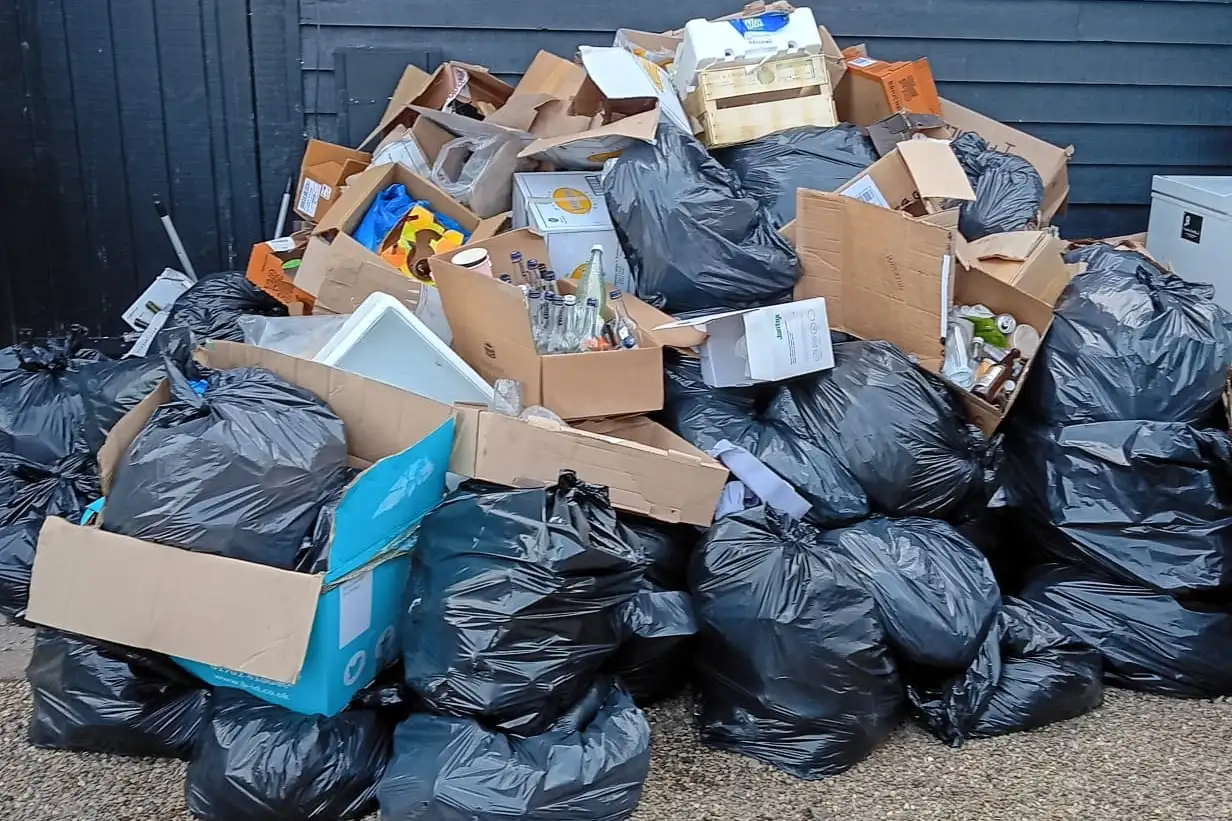
Want a price for yours? Send a photo on WhatsApp and we'll tell you the load size and the price.
Which businesses need one, and how long do you keep it?
Any business that hands its waste to someone else needs one, from shops and offices to trades such as builders and electricians. The gov.uk guidance counts waste from the part of your home you use for a business as business waste too (gov.uk (external site)). The business and the carrier each fill in their part of the note, sign it, keep a paper or electronic copy for 2 years, and show it to an enforcement officer from the council or the Environment Agency if asked (gov.uk (external site)). Regulation 35 says the note must be produced within 7 days of a demand.
If the same carrier collects the same type of waste from you regularly, a season ticket can cover all those collections for up to a year. The holder, the carrier and the type of waste must stay the same, or you need a new note. Alongside it you keep a schedule giving the date, time and quantity of each collection, such as the number of sacks, and you keep both for 2 years after the last one (gov.uk (external site)).
Two cases catch people out. Waste left behind when a tenancy ends isn't household waste: the code says clearing premises after they've been vacated, such as a landlord or letting agent clearing student housing, comes under the business duty of care, so the landlord needs the paperwork. Waste a builder or other tradesperson produces while working on your home is theirs to deal with under their own duty of care, and the code says the disposal cost should be in their price (code of practice, section 5.2 (external site)). Landlords clearing a let can read our end-of-tenancy clearance guide.
The code says failing the business duty of care is an offence with no upper limit on the courts' power to fine. An officer from the council or the Environment Agency who asks for a transfer note you can't produce can also issue a fixed penalty notice (code of practice, section 3.6 (external site)).
Do householders need a waste transfer note?
Householders don't need one by law. Under section 34(2A) of the Act, your duty is narrower: take all reasonable measures to make sure your household waste only goes to an authorised person. The code says the wider duty, "including the requirement for waste transfer notes", does not apply to you when you're dealing with household waste from your own home. That waste covers more than bin bags, and the code names old mattresses, furniture, household appliances and building waste (code of practice, sections 5.1 and 5.2 (external site)).
The main reasonable measure is a check. If a private business such as a house clearance firm takes your waste, the code says to check it has an up-to-date upper tier registration, and that includes a business that approaches you offering to take it. Search the Environment Agency register (external site) by registration number, business name or postcode, or call 03708 506 506 (code of practice, section 5.4 (external site)).
Keeping records is optional but worth it. There's no legal requirement to keep any, but if your waste is fly-tipped and the council investigates, records quickly show you met your duty. The code suggests noting the carrier's registration number, keeping a receipt with a registered operator's business details, photographing their registration, or noting the vehicle's registration, make, model and colour (code of practice, section 5.6 (external site)).
Bromley Council goes further and tells residents to "always obtain a waste transfer note as proof of the transfer to an authorised person". Its SCRAP advice also says to ask what is going to happen to your waste (Bromley Council (external site)).
What if a cash-in-hand collector dumps your rubbish?
Bromley Council's Trading Standards team warned residents in March 2026 after fly-tipping by unregistered carriers offering rubbish removal at low prices. It lists these warning signs (Bromley Council (external site)):
- Cash-only payments
- No paperwork or receipts
- No business address or contact details
- Very low prices compared with legitimate carriers
- Unmarked vehicles
The council's advice is that if a trader won't give you their waste carrier registration number, you shouldn't use them. You can report an unregistered collector anonymously to Crimestoppers on 0800 555 111.
If waste traced back to you went to someone who couldn't legally take it, and you didn't check them, gov.uk says you might have to pay a fixed penalty to your council or be prosecuted (gov.uk (external site)). Defra's guidance for councils in England sets that penalty at £200 by default, with a minimum of £150 and a maximum of £600, and an early-payment discount can't take it below £120 (Defra guidance (external site)). Paying within the 14 days clears your liability for the offence without a prosecution, and Bromley Council says a fine in a magistrates' court can reach £5,000 (Bromley Council (external site)).
Defra's guidance also tells councils not to penalise minor slips that don't lead to dumped waste, such as using an authorised carrier that disposes of the waste properly without checking it first. Bromley Council says legal action is most likely where the person who hired the collector doesn't respond to the council's enquiries or can't show they met their duty of care (Bromley Council (external site)).
Where does RLE Waste Clearance fit?
RLE Waste Clearance is an upper tier registered waste carrier, broker and dealer, number CBDU175566, with its own entry on the Environment Agency public register (external site). Every job, household or business, comes with a receipt and a waste transfer note. The note records what was taken and who took it, so keep it with your records in case anyone asks where the waste went. Everything we collect goes to a waste transfer station, where it's sorted.
You pay on completion, and businesses can be invoiced. A two-person crew does all the loading, and the price depends on how much of the truck your waste fills, from £60 plus VAT up to £360 plus VAT for a full 15 cubic yard truck, with transport and disposal included. Send photos on WhatsApp to 07534 244774 and we'll agree the price before the job.
For regular or trade waste, see commercial waste removal, office clearance and builders' waste. For rubbish someone else has dumped on your land, see fly-tipping clearance.
Council rules and charges change. We checked the council pages linked above when we wrote this, so check the council's own page before you book.
Need a waste transfer note?
Send a photo on WhatsApp and we'll price the load, from £60 plus VAT. Every job comes with a waste transfer note and a receipt.