Published Updated by the RLE Waste Clearance team
What are POPs, and why are sofas caught?
Persistent organic pollutants are chemicals that don't break down in the environment, and the government describes them as a danger to human health and the environment (gov.uk (external site)). Some flame retardants used in furniture are POPs.
The Environment Agency's guidance says upholstered seating often contains one of these chemicals, most commonly DecaBDE, on the back of the covers and in the foam. Lining and wadding that touch the foam or covers can be contaminated too, and the guidance covers any part made of or containing leather, synthetic leather, other fabric or foam (Environment Agency guidance (external site)).
Checking a sofa takes equipment. A site can scan it for bromine with an X-ray fluorescence device, and bromine means POPs are likely. The reuse guidance tells sites to check every item of waste upholstered seating or assume they all contain POPs (reuse guidance (external site)).
The law behind this is the POPs Regulation, kept in UK law as Regulation (EU) 2019/1021 (external site). Article 7 says waste containing POPs must be dealt with so the POP content "is destroyed or irreversibly transformed", and it bans any operation that would recycle or reuse the POPs themselves. The Persistent Organic Pollutants Regulations 2007 (external site) set out who enforces it and the penalties.
Which items count as upholstered seating?
The guidance defines waste domestic seating as any household-type seat that has become waste, whether it comes from a home or a business. Its examples are:
- Sofas and sofa beds.
- Armchairs, and recliner chairs whether electric or manual.
- Kitchen and dining chairs with a cushioned or fabric seat, back or arms.
- Stools, footstools and garden furniture.
- Futons, bean bags, and floor and sofa cushions.
- Office chairs that are fire resistant to domestic standards.
- Other padded household seats covered by fire regulations, which might include child car seats, highchairs and benches.
Seats with no padding or fabric, such as a plain wooden chair, are unlikely to contain POPs, and nor are deckchairs. Mattresses, beds, curtains, blinds, scatter cushions smaller than 60cm by 60cm and commercial seating of a type not used in the home aren't domestic seating under the guidance at all (Environment Agency guidance (external site)). The guidance adds that those items can still contain POPs. For a mattress, see mattress disposal.
Electric recliners carry an extra risk. The guidance says they may hold POPs in plastic parts, internal and external cables and printed circuit boards. Those parts fall outside the electrical waste (WEEE) regulations and are managed with the rest of the chair.
Want a price for yours? Send a photo on WhatsApp and we'll tell you the load size and the price.
What do the rules require?
The guidance is written for councils, waste firms and disposal sites, and it leaves little room. Waste seating containing POPs must be incinerated, normally at a municipal or hazardous waste incinerator, or a cement kiln, that's authorised to take POPs waste. No other treatment, recycling or disposal method is allowed, landfill included, and landfill operators must turn it away (Environment Agency guidance (external site)).
Seating also has to be kept apart from other waste during storage, collection and treatment. That covers a skip or container and the bays at household waste recycling centres and transfer stations. If seating does get mixed in, the whole load must be managed as POPs waste until the seating is separated, and the POPs must still be destroyed even if mixing has diluted them below the legal limit.
A collector can carry seating on the same vehicle as other items, provided it isn't mixed with them, isn't collected in a way that contaminates them, such as compaction, and comes off separately at the other end. A compacting bin lorry used for seating must carry seating only. On paper, the waste transfer note must describe it as "domestic seating waste containing POPs" with the list of waste code 20 03 07.
Recycling is tightly limited too. A site can only take materials out for recycling if it can show they carry no dust, fabric or foam containing POPs, and metal parts can go to an authorised smelter.
What do the rules mean for sofa disposal?
A sofa in good condition can still be reused. Under the Environment Agency's reuse guidance, a sofa you give to a charity shop isn't waste if it meets every reuse condition. The conditions include that it's used again as seating, that you meant it to be reused, that it needs no more than a minor repair, and that its use keeps to the law, for example by carrying the right fire safety labels (reuse guidance (external site)).
A new leg on a sofa counts as a minor repair, but a sofa that has collapsed in the middle needs more than that, so it's waste. A sofa you hope to donate also mustn't be stored where it could be damaged, such as in a skip with other waste. Check the fire label is still attached before you ring a charity.
Some council bulky collections now handle seating separately. Croydon collects sofas, armchairs and other upholstered furniture on a separate visit from the rest of a booking, with both visits on one day and arranged by its contractor (Croydon Council (external site)). Dartford says affected items "may be collected separately, and on a different date" (Dartford Borough Council (external site)).
Bromley's bulky waste page doesn't mention POPs. It charges a minimum of £43 and collects from the front of the property, never the public highway, within 10 working days of payment (Bromley Council (external site)). Prices and item limits for ten councils are in our council bulky waste comparison.
Leave the sofa whole. The guidance says contamination happens when pieces of foam, cover, lining or wadding come loose, and a site needs an environmental permit to strip foam and fabric out of seating. Cutting a sofa up and bagging the foam with your household rubbish mixes exactly what the rules are trying to keep apart. If you've hired a skip, ask the skip firm before a sofa goes in it.
How do you check who takes your sofa?
Whoever handles your sofa disposal has to be allowed to carry waste. The government's Dispose of household waste (external site) page says you could be fined if you give household waste to someone who isn't legally allowed to take it, for example if something fly-tipped is traced back to you.
Ask for the waste carrier number and look it up on the Environment Agency's register of waste carriers (external site). For a private business, such as a clearance firm, gov.uk says to select "upper tier". If a charity is collecting a sofa, the same page says to check it's on the register at lower tier.
Be wary of anyone who can't give you a carrier number. Keep the paperwork as well, because a waste transfer note or receipt shows who took the sofa if anyone asks later.
Where does RLE Waste Clearance fit?
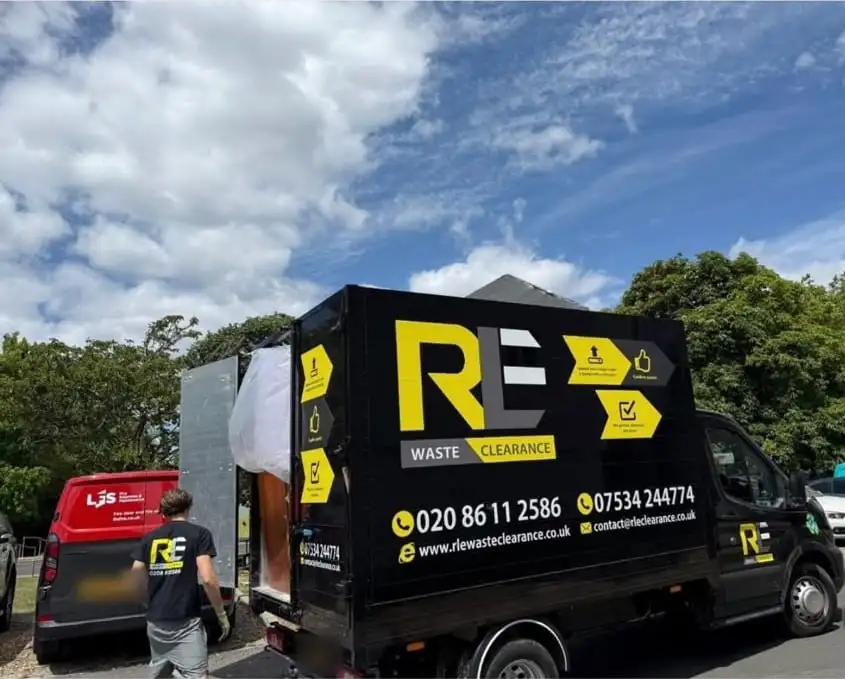
RLE Waste Clearance takes sofas, armchairs and other furniture as part of a load. We're based in Chislehurst and work across Bromley, Bexley and south-east London. Our two-person crew does all the loading, carrying the sofa out from wherever it is in the house or flat, and we take sofas and armchairs in the same visit as everything else, so nothing is left waiting outside.
Sofa disposal with us is priced by the space the sofa takes in the truck, not as a separate item. Loads run from £60 plus VAT for a minimum load, roughly a few bags or one armchair, to £360 plus VAT for a full 15 cubic yard truck, with transport and disposal included. We agree the price from photos on WhatsApp before the job, you pay on completion, and you get a waste transfer note.
We're an upper tier registered waste carrier, CBDU175566, so you can check us on the register before we arrive. Send a photo of the sofa and your postcode to 07534 244774 for a price. For more than one room, bulky waste collection in Bromley, flat clearance and house clearance cover the bigger jobs.
Council rules and charges change. We checked the council pages linked above when we wrote this, so check the council's own page before you book.
Got an old sofa to shift?
Send a photo on WhatsApp and we'll price the load, from £60 plus VAT. Our two-person crew carries the sofa out for you.